- Calories
- 250
- Protein
- 7g
- Fiber
- 3g
- Sat. fat
- 4g
- Sodium
- 480mg
- Added sugar
- 0g
What this recipe does for you.
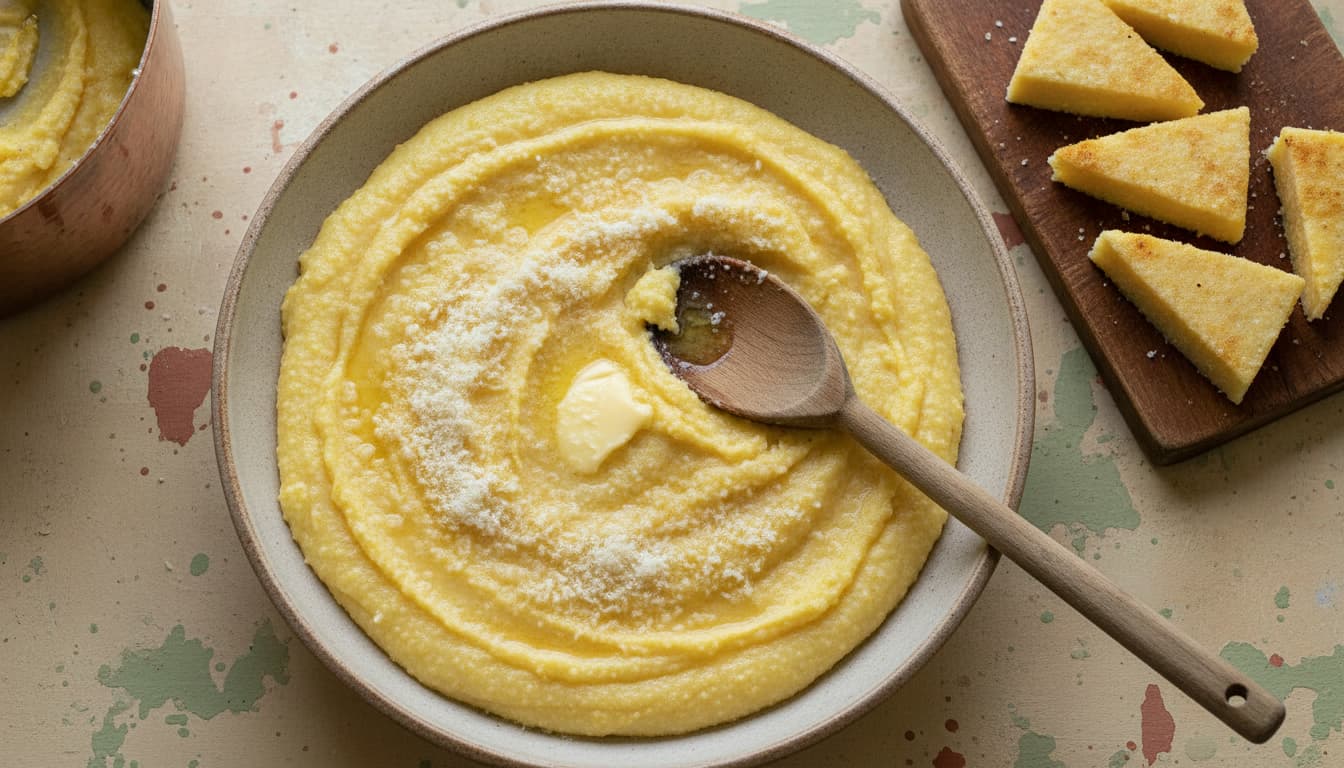
Gritty polenta is undercooked polenta, and the pack instructions are the reason. Corn starch granules need time and water to hydrate fully, which means one part coarse cornmeal to five parts liquid and forty-five minutes at a heat so low the surface only blips. Salt goes in with the water, the whisk only comes out at the start, and the butter and cheese go in off the heat.
Why this works
Every recipe on this site ships with an explanation of the technique decisions, why sear then braise, why the acid goes in at the end, why the fat renders before the aromatics. The method below is those decisions, in order.
Ingredients
Serves 6- 1 1/2 cupscoarse stone-ground cornmeal · polenta grind, not instant, not fine cornmeal, not masa
- 6 cupswater · or 4 cups water and 2 cups whole milk for a richer version
- 2 tspkosher salt · added to the liquid before the cornmeal goes in
- 1 pinchbaking soda · about 1/8 tsp, optional, it speeds hydration noticeably
- 3 tbspunsalted butter · cold, cut into cubes, stirred in off the heat
- 3/4 cupParmigiano-Reggiano · finely grated, added off the heat
- 2 tbspextra-virgin olive oil · to finish, or in place of the butter for a dairy-lighter version
- 1/4 tspblack pepper · freshly ground
- 1 cupwater · extra, kept warm, for loosening as it thickens
Method
Buy coarse stone-ground, and know what you are not buying
Polenta is a grind, not a species of corn. You want coarse stone-ground yellow cornmeal, where the pieces are visibly distinct like coarse sand. Instant polenta is precooked and dried and gives you something smooth in five minutes with almost no corn flavour. Fine cornmeal turns to paste. Masa harina is nixtamalised and belongs in tortillas. Grits are the same idea from a different corn variety and cook similarly, so a bag of stone-ground grits is a legitimate substitute.
One to five by volume, not the one to four on the bag
One and a half cups of cornmeal to six cups of liquid. Pack instructions almost always say one to four, which produces polenta that sets stiff in the pot before the granules have finished hydrating, which is exactly the gritty texture people complain about. More water buys you time. If it thickens past the point you want before forty-five minutes are up, add warm water a quarter cup at a time. You cannot add water back into a granule that has already set.
Salt the liquid, not the finished pot
Two teaspoons of kosher salt into the water before the cornmeal goes anywhere near it. Salt dissolved in the cooking liquid seasons each granule as it hydrates, from the inside. Salt stirred into finished polenta sits in the liquid between granules and tastes like salt on top of bland corn, which is the same principle as salting pasta water. Under-seasoned polenta is the second most common complaint after grittiness, and this is the fix.
Rain the cornmeal in with a whisk going, then put the whisk away
Bring the salted water to a boil, then pour the cornmeal in a thin steady stream from your fist while whisking continuously with the other hand. Thirty seconds of pouring, and never dump it in at once, because the outside of the clump gelatinises instantly and seals dry meal inside it. Once it is all in and there are no lumps, switch to a wooden spoon. A whisk used through the whole cook aerates the polenta and makes it gluey.
The heat is lower than you think, and a diffuser earns its keep
Drop the heat until the surface only blips every few seconds, which on most gas ranges is the lowest setting the burner will hold. Polenta at a real simmer spits molten cornmeal, and it burns skin, so a splatter screen or a partially set lid is a genuine safety item rather than a nicety. If your stove will not go low enough, a heat diffuser or an inverted cast iron pan under the pot solves it. Scorched polenta cannot be rescued.
Forty-five minutes, stirring every five, and here is what stirring is for
You do not need to stir constantly, despite the folklore. You need to stir well every five minutes, all the way into the corners with a wooden spoon or a flat-edged spatula, to stop the bottom catching and to break up the skin forming on top. That is about nine stirs across the cook, each of twenty seconds. Set a timer if you are doing anything else, because the one time you forget is the time it catches.
How to tell it is actually done, without guessing
Take a small amount on a spoon, cool it for ten seconds, and press it against the roof of your mouth with your tongue. If you feel individual grains, it is not ready, no matter what the clock says. Done polenta is creamy with a faint pleasant coarseness rather than distinct grit, and it pulls away from the side of the pot when you drag a spoon through it. Coarse grinds can need an hour. Taste rather than time it.
The pinch of baking soda, and why it works
An eighth of a teaspoon of bicarbonate in the water raises the pH slightly, which helps the starch granules swell and break down faster, and it can cut fifteen minutes off a stubborn coarse grind. This is the same chemistry that makes beans cook faster in alkaline water. Use more than a pinch and you get a soapy taste and a slick, almost slimy texture, so measure it rather than shaking it in. It is optional, not a shortcut to a half-hour polenta.
Butter and cheese off the heat, always
Kill the heat, wait a minute, then beat in the cold butter cube by cube and the grated Parmigiano in two additions. Cheese added to polenta over direct heat separates, and you get oily strings sitting on the surface instead of a glossy emulsion. Cold butter emulsifies more reliably than soft butter for the same reason it does in a pan sauce. Taste for salt one final time here, because the cheese has just added a significant amount.
Serve it immediately, because it starts setting the moment it stops moving
Soft polenta has a working window of about ten minutes on the stove with the lid on, and it thickens continuously as it cools. Warm the bowls. If it stiffens while you plate, beat in a splash of hot water off the heat and it comes straight back. A skin on top is normal and stirs back in. What does not come back is polenta that has been held for an hour, which sets into a block regardless of how much liquid you beat into it.
The leftovers are the best part, so plan for them
Pour the remainder into an oiled loaf pan or a rimmed sheet, smooth the top, and refrigerate. In four hours it sets firm enough to slice. Cut it into fingers or wedges, brush with olive oil and either roast at 425F for twenty-five minutes, griddle in a hot cast iron pan, or shallow fry until the outside is crisp and the inside stays creamy. Set polenta keeps five days refrigerated and it fries better on day two than on day one.
What goes on top, and the rule that governs it
Polenta is a base for something with liquid and acid, because on its own it is rich and one-note. A slow-braised ragu, mushrooms cooked hard in olive oil with garlic and thyme, sausage and peppers, braised greens with chili and lemon, or a simple tomato sauce with a lot of basil. It is naturally gluten-free, which makes it the most useful starch to keep on hand for a mixed table, and the vegan version made with olive oil and nutritional yeast instead of butter and Parmigiano is genuinely good rather than a concession.
The oven method, for when you will not stand at the stove
Whisk the cornmeal into boiling salted water in an oven-safe pot exactly as written, cover, and put it into a 350F oven for forty minutes. Stir once at the twenty-minute mark. Enveloping heat means nothing catches on the bottom, so you get two of the three stirs back and the pot needs no supervision. It comes out marginally less creamy than the stovetop version because you have agitated it less, and beating in the butter and cheese vigorously off the heat closes most of that gap.
Grits, cornbread cornmeal, and what actually substitutes
Coarse stone-ground grits behave near-identically and can be swapped one for one, allowing five extra minutes. Medium-grind cornmeal sold for cornbread will make something edible in half the time, thinner and less characterful, and wants the ratio pulled back to one to four. Instant polenta is precooked and dried and is a genuinely different product, not a time-saving version of this one. Masa harina is nixtamalised with lime and tastes of tortilla, so it is not a substitute in any direction.
Variations
Substitutions and adaptations land with the photography shoot. The method holds across most reasonable swaps.
Storage
Refrigerator: 3 to 4 days, sealed. Freezer: up to 3 months. Reheat covered to retain moisture.
Why we tested this polenta: one to five, forty-five minutes, salted early 3 times.
Every flagship recipe on this site goes through at least three rounds of kitchen testing before publication. We log what changed between tests so you can see the recipe's evolution, and so we can't quietly drop the failures.
- 01
Test 1
- What we tried
- Followed the one-to-four ratio on the bag, cooking for the thirty minutes it recommended.
- What happened
- The pot went stiff at eighteen minutes and the finished polenta was gritty against the roof of the mouth.
- What we changed
- One part cornmeal to five parts liquid, forty-five minutes minimum, with warm water on standby.
- 02
Test 2
- What we tried
- Stirred in the Parmigiano over low heat rather than off it, to save a step.
- What happened
- The cheese broke and left oily strings and a grainy film on the surface within a minute.
- What we changed
- Heat off, one minute of rest, then cold butter and cheese beaten in.
- 03
Test 3
- What we tried
- Salted the polenta at the end, seasoning to taste like a soup.
- What happened
- It took nearly double the salt to taste seasoned, and it still read as salt sitting on top of bland corn.
- What we changed
- Two teaspoons of kosher salt into the water before the cornmeal goes in.
Frequently asked
- What is the correct water to polenta ratio?
- One part coarse cornmeal to five parts liquid by volume, so one and a half cups of polenta to six cups of water. Most packets say one to four, which sets the pot before the granules have fully hydrated and gives you the gritty texture people blame on the brand. Keep a cup of warm water beside the stove and loosen as needed. For a firmer polenta you plan to chill and slice, one to four is correct, but only because you want it stiff.
- How long does polenta take to cook?
- Forty-five minutes for coarse stone-ground, and up to an hour for a very coarse grind. Instant polenta takes five minutes and tastes like it. Test by texture rather than by clock: press a cooled spoonful against the roof of your mouth, and if you feel individual grains it needs longer. A pinch of baking soda in the cooking water can shave ten to fifteen minutes off by helping the starch granules swell, though it will not turn a forty-five minute job into a ten minute one.
- Do you have to stir polenta constantly?
- No, and that instruction has put a lot of people off making it. Stir thoroughly for the first minute as the cornmeal goes in, then well every five minutes, getting into the corners of the pot with a flat-edged wooden spoon. That is around nine stirs of twenty seconds each. What you must do is keep the heat genuinely low, because a pot at a real simmer will catch on the bottom between stirs and spit scalding cornmeal at you.
- What is the difference between polenta, grits and cornmeal?
- Polenta is coarsely ground yellow corn, traditionally flint corn, from northern Italy. Grits are ground from dent corn in the American South and are often, though not always, nixtamalised. Cornmeal is a catch-all term covering everything from coarse to flour-fine. Cooked the same way, coarse stone-ground grits and polenta are close enough to substitute directly. Instant and quick versions of either are precooked and dried, and they behave nothing like the whole grind.
- Is polenta gluten-free and is it healthy?
- Corn contains no gluten, so plain polenta is naturally gluten-free, though anyone with coeliac disease should check for a certified mill since shared equipment is common. Nutritionally it is a whole grain when stone-ground, with about 3g of fiber per serving here, and it is lower in calories than most people assume. What decides the plate is what goes on top and how much butter and cheese goes in, not the corn.
- Can I make polenta ahead of time?
- Soft polenta does not hold well, because it thickens continuously and sets into a block within an hour. You can keep it loose for about thirty minutes in a covered pot over the lowest possible heat, beating in hot water as needed, or in a bowl set over barely simmering water. The better make-ahead plan is to cook it deliberately in advance, pour it into an oiled pan to set, then slice and griddle or roast it, which is a different and arguably better dish.
- Can I make polenta with milk instead of water?
- Partly, and it is worth doing. Two cups of whole milk with four cups of water gives a noticeably richer, creamier result without the scorching risk that all-milk brings. Milk proteins catch on the bottom of the pot far more readily than water does, so an all-milk polenta needs constant attention and a diffuser. If you use milk, cut the added butter back, since you have already added fat and the finished dish can tip into heaviness.
- How do I fix gritty polenta?
- Add half a cup of hot water, put the lid on, and keep it at the lowest possible heat for another fifteen to twenty minutes, stirring every five. Grittiness is unhydrated starch, and the only cure is more water and more time. What will not fix it is more butter, more cheese, or a stick blender, all of which mask the texture briefly and then make the polenta gluey. Taste again by pressing a spoonful against the roof of your mouth.
Related recipes
See all →Gazpacho: An Emulsion, Not a Cold Tomato Soup
The Andalusian version is thick, orange-pink and creamy without any dairy in it, and the two things that get it there are stale bread and olive oil poured in slowly at the end. Watery red gazpacho is a blender-order problem. It needs genuinely ripe tomatoes, sherry vinegar rather than any other kind, and four hours in the fridge, which the time on this page includes.
270m4g ProteinTabbouleh: A Parsley Salad With Bulgur In It, Not the Reverse
Almost every tabbouleh sold outside the Levant has the ratio backwards: a bowl of wet bulgur with parsley stirred through. The Lebanese version is three quarters herbs by volume, with fine bulgur used the way you would use breadcrumbs, soaked in tomato juice rather than boiled. Forty-five minutes, no cooking at all, and most of the work is drying parsley and chopping it properly.
45m4g ProteinCarbonara: Four Ingredients, One Temperature, No Cream
Carbonara is not a cream sauce and it is not scrambled eggs. It is an emulsion of egg yolk, rendered pork fat, grated sheep cheese and starchy pasta water, held together by heat that stops just short of setting the egg. Everything that goes wrong goes wrong in the last ninety seconds. Thirty minutes, four ingredients, and a pan that comes off the burner before the eggs arrive.
30m27g Protein
Get a tested recipe + a nutritional note in your inbox each Sunday.
One recipe a week, photographed on the same Tuesday it tested. Reviewed by an RD. No promotions, no pop-ups, no tracking.
The Clean Chef Starter Kit.
A 14-day anti-inflammatory meal plan PDF, grocery list by section, macros totaled per day, Sunday prep sequence. Free.
By subscribing, you agree to our Privacy Policy. One calm email a week. Unsubscribe anytime.
We're building a shop.
Curated cookware, pantry staples we actually buy, recipe-bundle PDFs. Be the first to know when it opens.
We'll only email you about the shop opening. Unsubscribe in any email. See our Privacy Policy.